Doctoral and ongoing
Microfabricated electrochemical sensor platforms
01
Research problem
A biosensor is only as reproducible as the electrode under it. Commercial screen-printed electrodes vary from piece to piece and cannot be multiplexed freely. Measuring several targets, or many replicates, needs electrodes made with semiconductor precision.
02
Project objective
Design and fabricate miniaturised chips that give every assay a clean, reproducible gold surface and a complete electrochemical cell, and scale from single sensors to multiplexed arrays with multichannel readout.
03
My contribution
- Fabricated chips using photolithography, sputtering, PECVD, reactive-ion etching and wet etching
- Investigated single-electrode and multiplexed layouts
- Electroplated and chloridised on-chip Ag/AgCl reference electrodes at wafer level, and prepared chips for packaging and measurement
- Characterised fabricated surfaces and troubleshot variability between cells
04
Methods and experimental approach
- Si/SiO₂ substrates; electrodes and contact pads defined by photolithography (MA6/BA6 mask aligners)
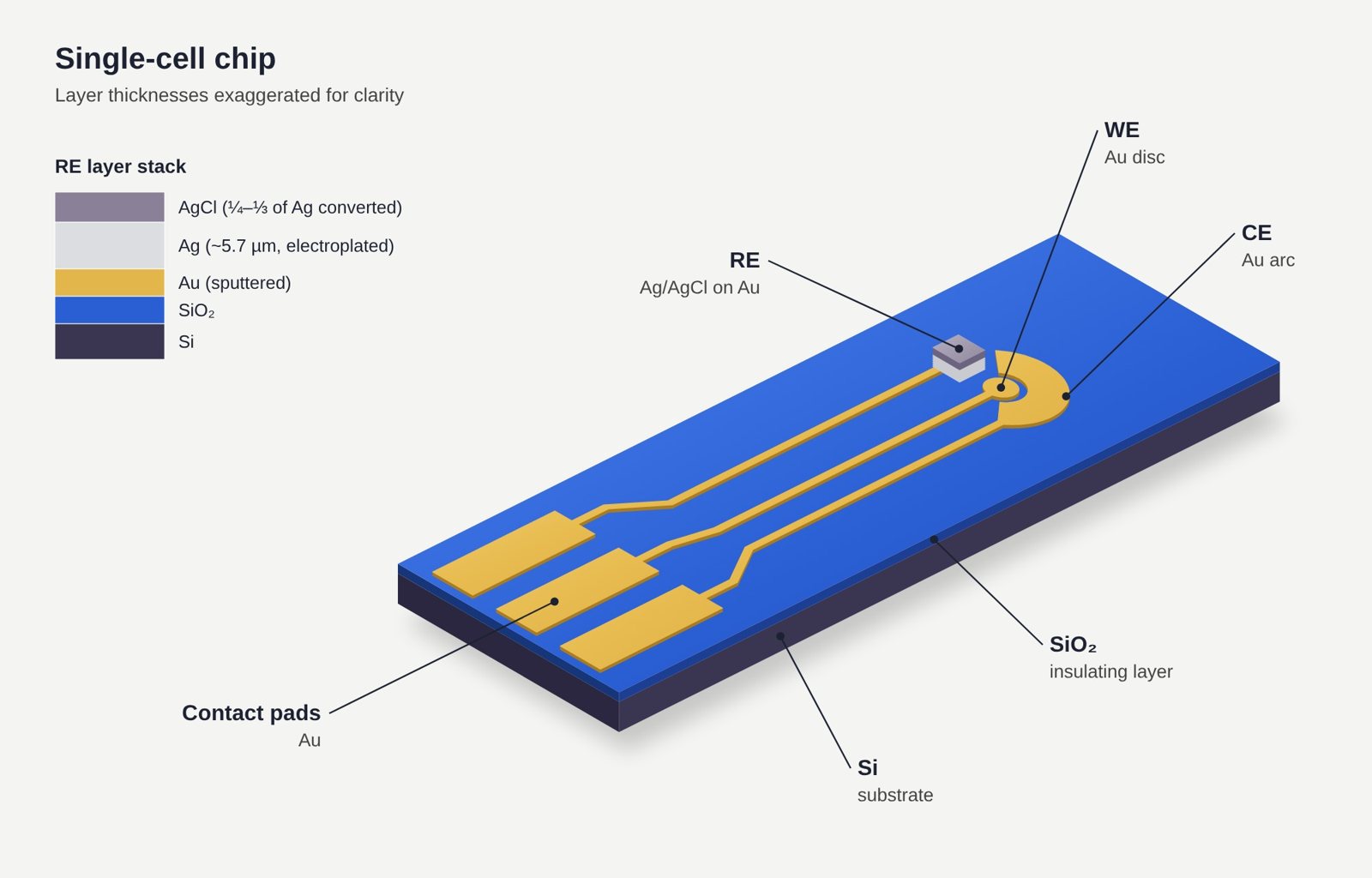
- Magnetron-sputtered thin-film gold; PECVD silicon nitride passivation of connections
- Reactive-ion and wet etching; profilometry and optical microscopy
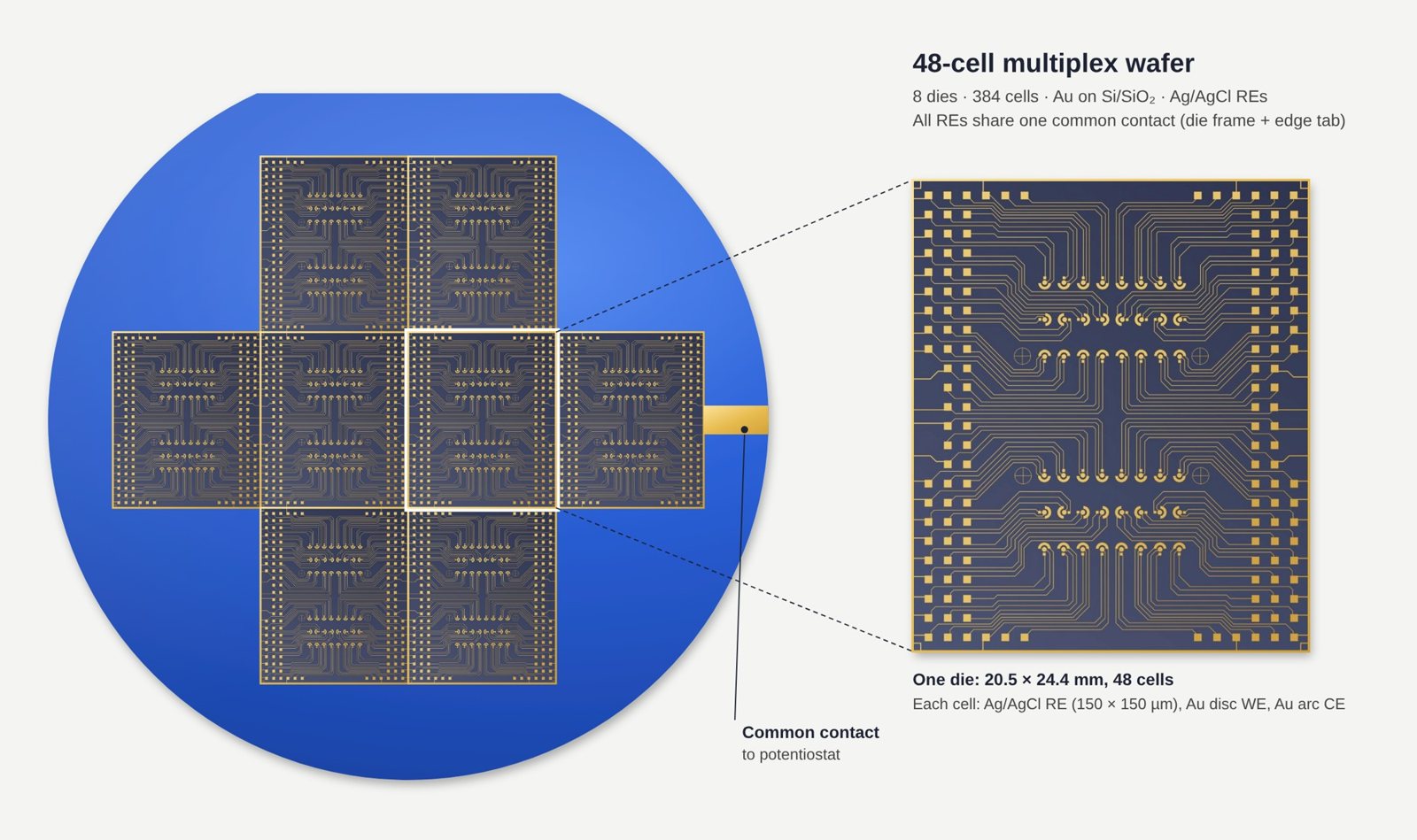
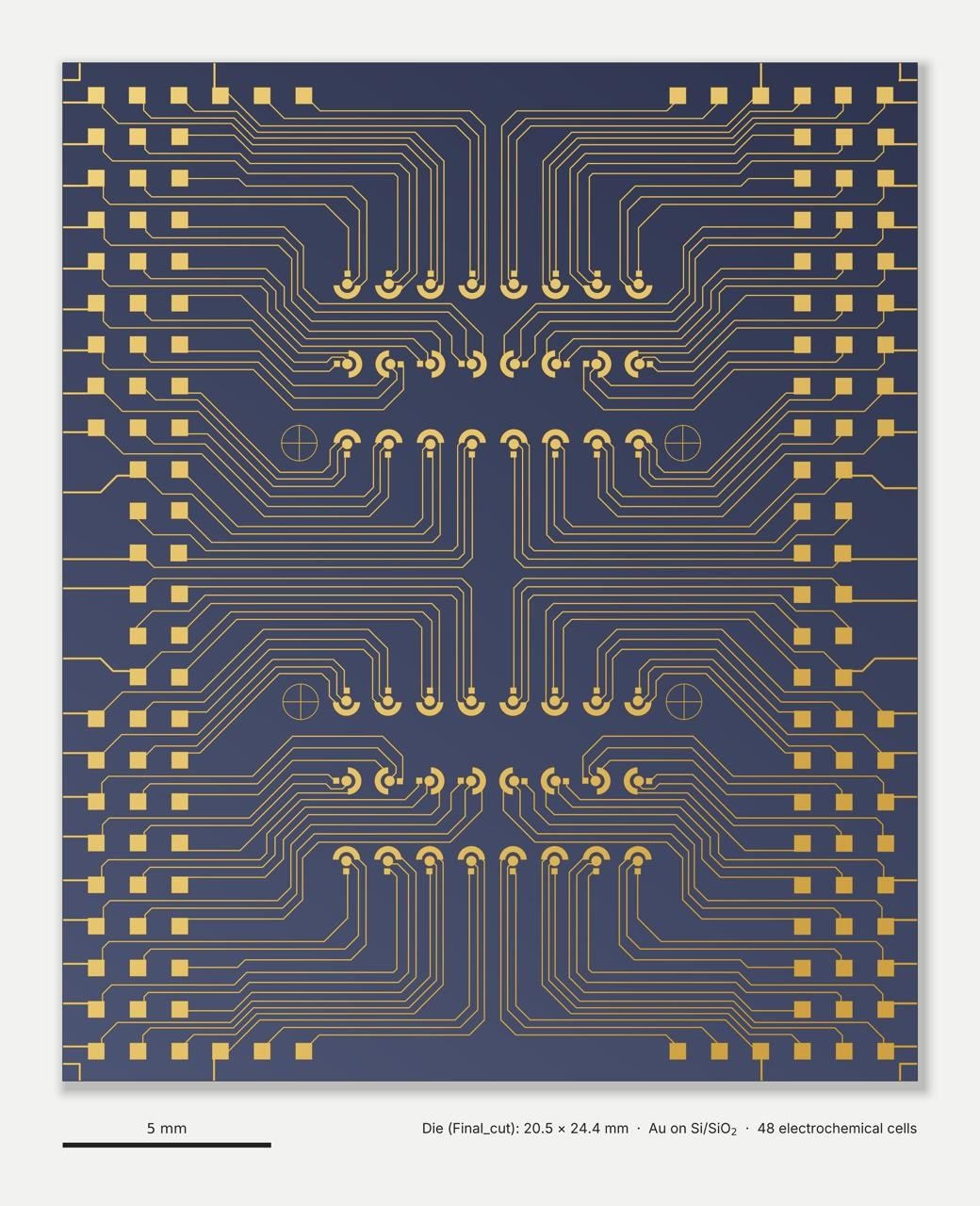
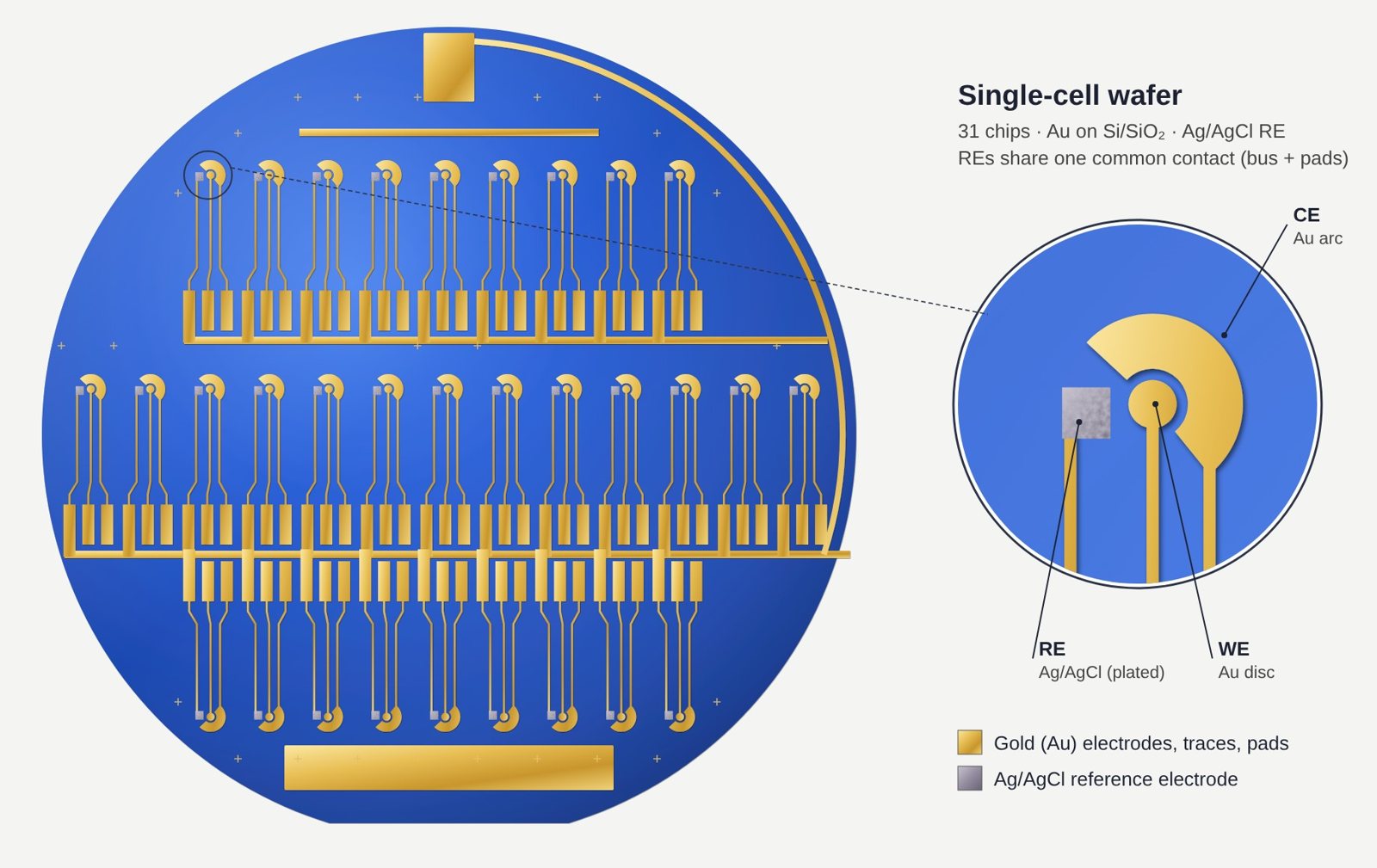
- 48 individual cells per die, eight dies per wafer; single-cell wafers carry 31 chips
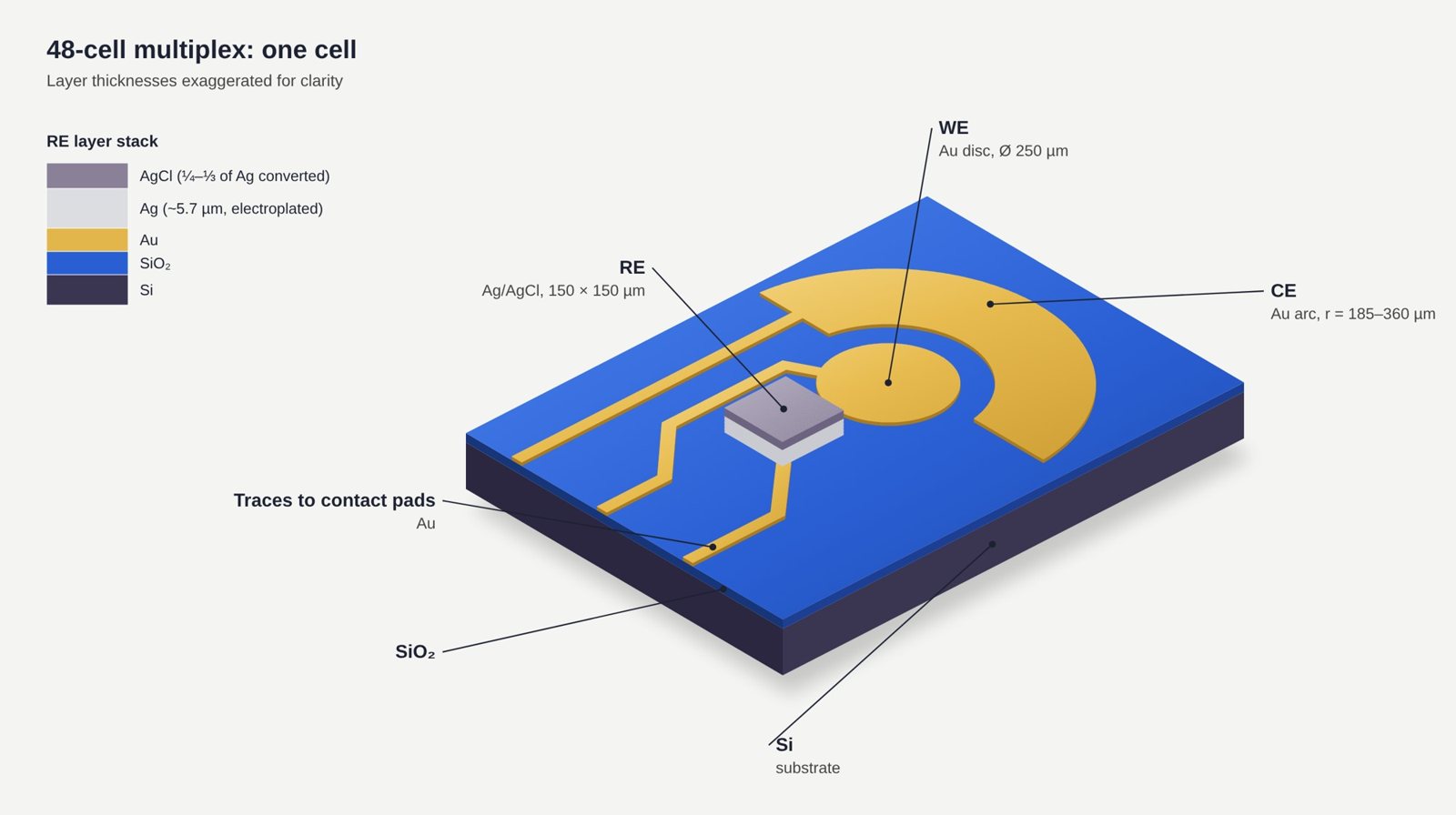
- Wafer-level electroplating of silver (~5.7 µm) onto the gold reference pads through a shared contact, then partial chloridisation to Ag/AgCl
- PDMS moulds and epoxy frames to hold membranes and electrolyte; multichannel potentiostats (PalmSens MUX8)
05
Key findings
Multiplex chip specifications
| Die size | 20.5 × 24.4 mm |
|---|---|
| Materials | Thin-film gold on Si/SiO₂ |
| Cells per chip | 48, individually addressable |
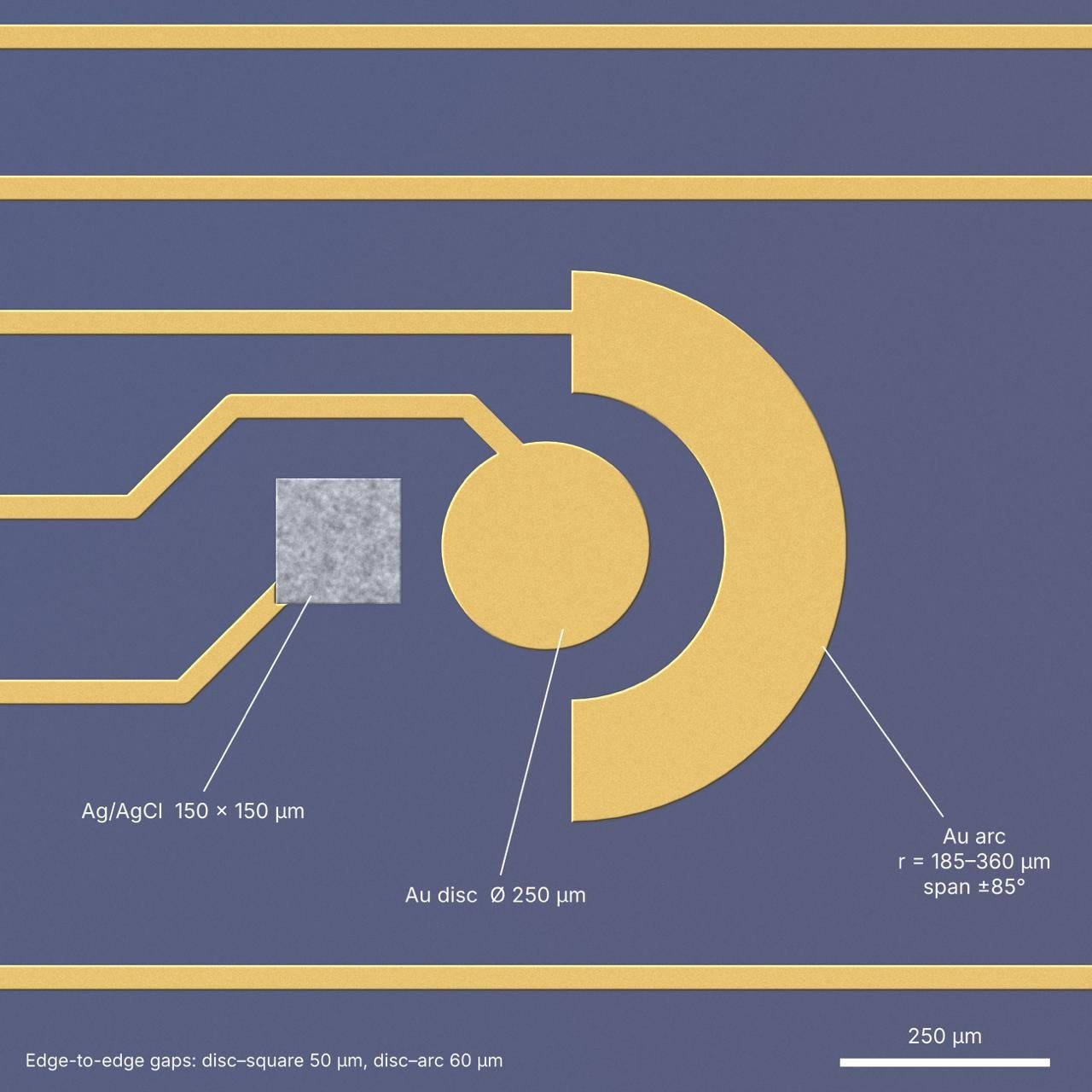
| Working electrode | Gold disc, Ø 250 µm |
| Counter electrode | Gold arc, r = 185–360 µm, span ±85° |
| Reference electrode | Ag/AgCl, 150 × 150 µm |
| Electrode gaps | 50 µm (disc–reference), 60 µm (disc–arc) |
- The chip design has been adapted for antibody, enzyme, DNA and ion-selective interfaces in different projects
- Supported the published microcystin, pathogen and ethylene sensors and the patent application
- Ongoing work improves usable-cell yield and process repeatability on the 48-cell format
06
Images and data
48-cell multiplex chip: wafer → die → cell
Single-cell chip: wafer → chip
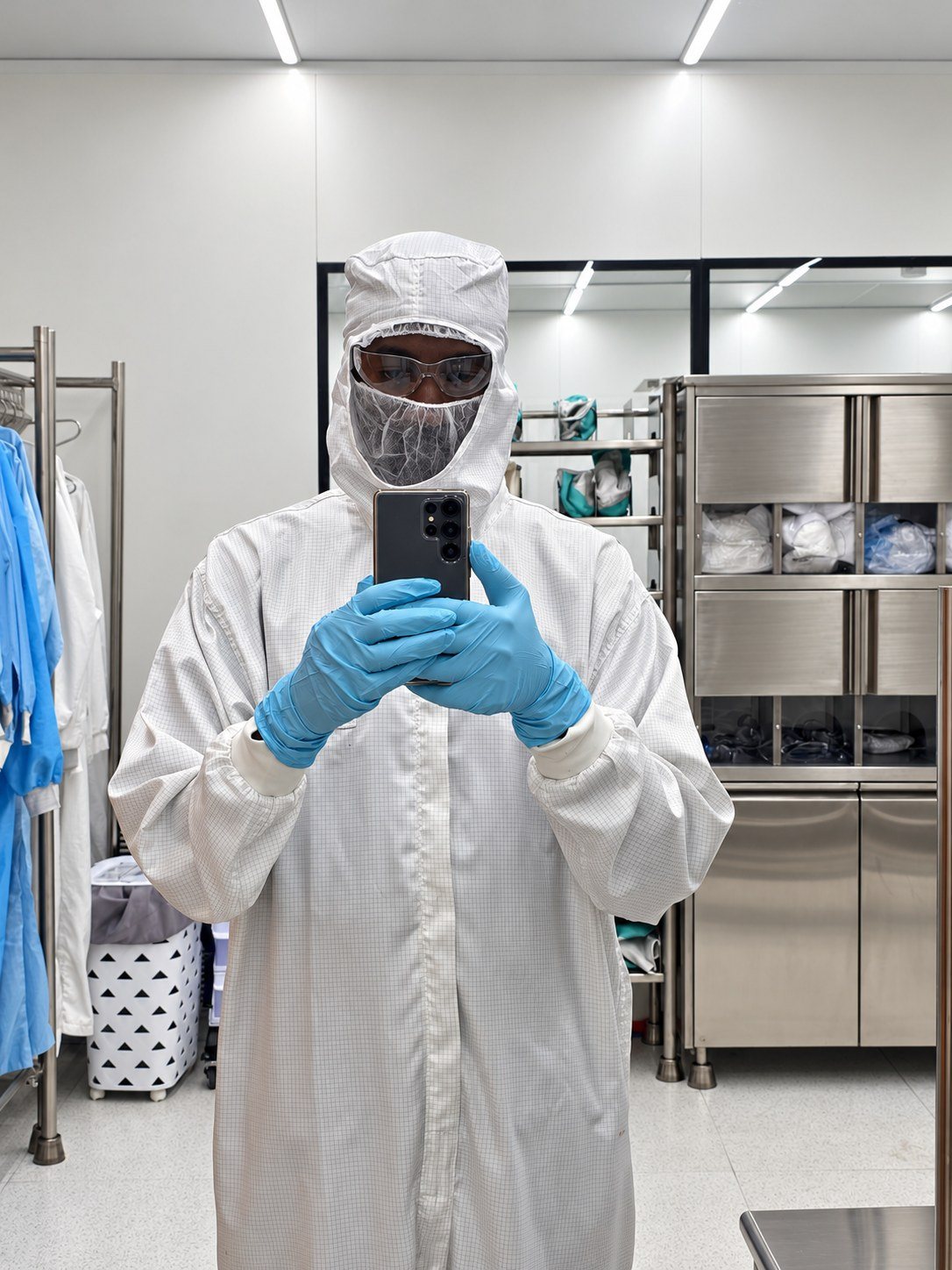
In the cleanroom
07
Publications and related outputs
- Rapid detection and quantification of microcystins in surface water by an impedimetric immunosensor. Sensors and Actuators B: Chemical, 2021. DOI ↗
- Real-time chip-based impedimetric detection of cyanotoxins in treated wastewater. ACS ES&T Water, 2025. DOI ↗
- Biocomposite-based electrochemical chip for ethylene detection. Sensors and Actuators B: Chemical, 2023. DOI ↗
- Comparative evaluation of electrochemical and fluorescent readouts for immunomagnetically captured waterborne pathogens using a biochip with bifunctional magnetic nanoparticles. ACS Measurement Science Au, 2026. DOI ↗
- Patent application: integrated multi-method electrochemical biosensor. PCT/IL2021/051409 · US 2025/0264433 A1